

14 Jun 2026 The comeback coach
By Donna Lampkin Stephens
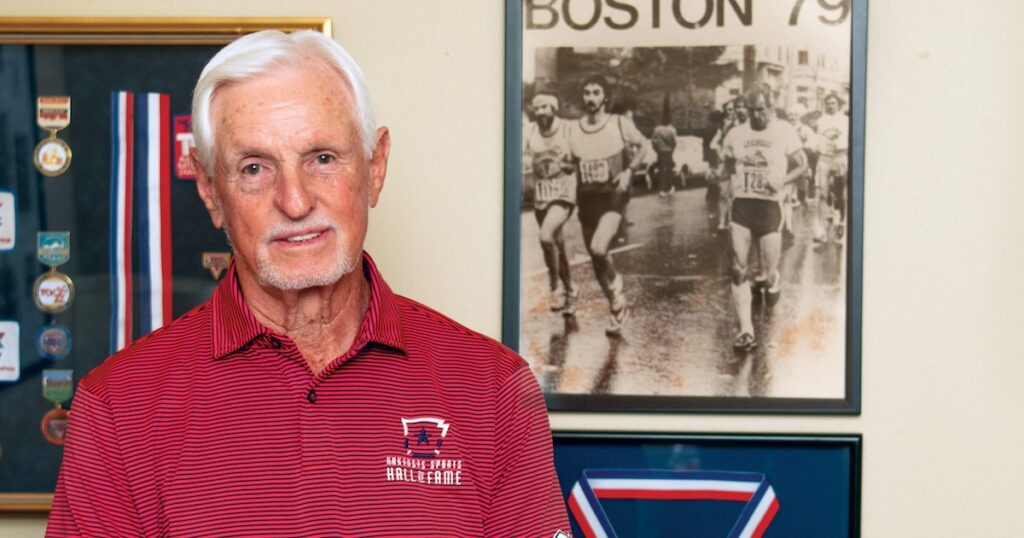
The list of Henry Hawk’s athletic accomplishments is long and impressive, but his proudest accomplishment has been his work with quadriplegic patients.
The Conway man has been a personal trainer for five people over the years who surpassed their initial prognoses.
“They’re all walking now,” Hawk said. “They can do things they never thought they’d be able to do.
“It’s the most rewarding thing I’ve done.”
He grew up in Conway, where his love of athletics was sparked by iconic coach Raymond Bright. He played football and ran track at the University of Central Arkansas under Frank Koon, earned a degree in physical education and went on to coach for 19 years. He was an assistant on Ken Stephens’ 1965 state championship team at North Little Rock, and after a stint working under Bright at UCA, he succeeded Stephens at NLRHS and led the Wildcats to a state title in 1972.
Among his sports highlights are:
• All-State and All-America honors in football.
• Football state championships as a coach.
• 10 Boston Marathons with a best time of 2 hours, 42 minutes.
• State championships in road races from 5K to marathon.
• 36 national titles in masters track and field.
• World record in the mile (60-64 age division) of 5:13.27.
• Numerous Hall of Fame inductions.
In 1980, he left coaching to open businesses in Conway — a sporting goods store and a fitness center, where he embarked on his exercise class era. Over the years, he taught classes at Centennial Valley Country Club in Conway and Baptist Health in Little Rock, where he started a fitness program for seniors. He and his wife, Jane, also opened Henry Hawk Real Estate.
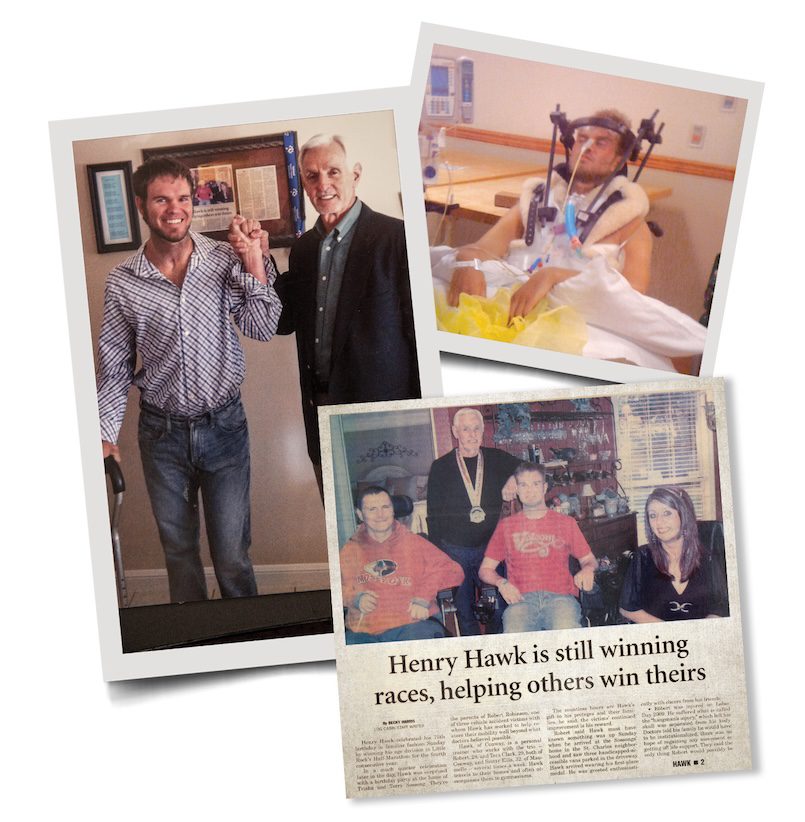
One of his fitness students at Centennial was Trisha Sossong, whose son, Robert Robinson, then 25, suffered a devastating four-wheeler accident. He became Hawk’s first and most serious rehabilitation client.
“He went through a single-bar gate and was internally decapitated,” Hawk said. “That breaks the C1 vertebra, and it normally breaks the spinal cord, which kills you. His stretched 8 inches and didn’t break. They recommended to let him die because they thought he would be able to move nothing but his eyelids.”
Sossong would have none of that.
“Henry reached out to me and said, ‘I’m not a physical therapist, but I know how the body works. If you want me to, I’ll be glad to come over and work out with Robert.’”
Hawk remembers the initial meeting.
“I walked in, and he’d just got his trach out,” he said. “He couldn’t swallow water; he could hardly speak; he had a feeding tube. I said, ‘God, I’ve got us a good one.’ I worked with him for about 12 years. We became like brothers, really.”
With Hawk’s exercise program, meeting Robinson where he was, the spinal cord eventually recovered enough that he is able to walk slowly on a treadmill. Now 42, he works with the family business, Prime Auto Sales.
Sossong said that purpose gave her son a reason to want to live.
“I think Robert would be dead today if it wasn’t for Henry,” she said. “Most quadriplegics live an average of 10 years (following the accident) and have a horrible life. Henry built back a muscle structure and gave him hope and kept him in good enough shape that he has more hope.
“There’s no doubt — mentally, physically, all around, Henry gave him a life he would never have had otherwise.”
Over the years, Hawk has worked with four other accident victims, all of whom have shown remarkable improvement. He said he used only three pieces of equipment for his private clients as well as his classes — sets of 5- and 10-pound weights and a 6-foot rope. But he also focused on their internal motivation.
“It’s just like coaching football players,” he said. “I told them, ‘If I ever think you’ll be less than 80 percent, I’ll go home. You’re not getting any good out of it and I’m not getting any good out of it.’
“I gave each one a gold medal and told them first, ‘I want you to know how much work it takes. If you start feeling bad, you look at that medal.’”
He has also worked with clients with less serious but still incapacitating flexibility and mobility issues. “They’re doing it at their level, what they’re capable of doing, and then you progress,” Hawk said of his philosophy. “They do not have to have the big equipment. This guy goes from near death, and most of [the exercise program] was in a chair. People think they’ve got to have a lot of expensive equipment, but you don’t. You could take a Kroger bag, put two cans of food in there and do wonders with it.”
While he said he is no longer taking clients, Hawk continues to work out in his office (stretching, weights, etc.) daily, and he plays 18 holes of golf several days a week. “I figure if you can do that at 89, you ought to make it to 90,” he said, and grinned.

- The comeback coach - June 14, 2026
- From tragedy to purpose - May 10, 2026
- The Wednesday Table - March 15, 2026