
18 Jul 2026 Her part in victory
By Vivian Lawson Hogue
In America’s Second World War, our military system experienced changes from World War I, other than war machinery, battle techniques and materiel. There was also that thing called “patriotism” that held the country together for four to six years. There was also a distinct change in personnel as well, with the introduction and acceptance of women into military ranks.
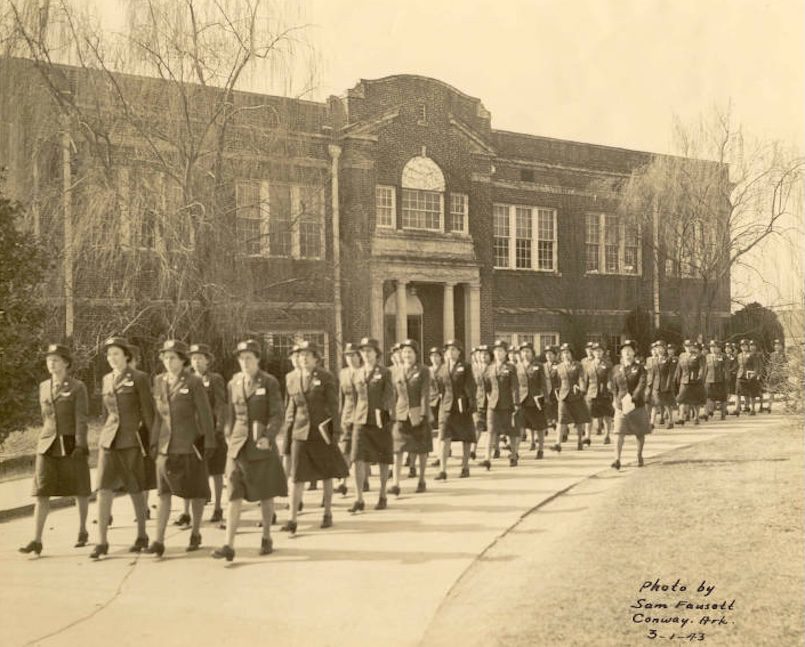
Where women had primarily served as nurses and secretaries during World War I, they became part of the war effort in 1942 through a branch of the United States Naval Reserve called Women Accepted for Volunteer Emergency Service, or WAVES. A second branch was the Women’s Army Corps, or WACs, which was the women’s branch of the United States Army. It achieved active-duty status in 1943. These approximately 186,000 women enabled more men to take on combat duty and demonstrated that women could perform essential military tasks. Conway was one of only a few WAC training centers in the nation, with its headquarters located at Arkansas State Teachers College (now University of Central Arkansas).
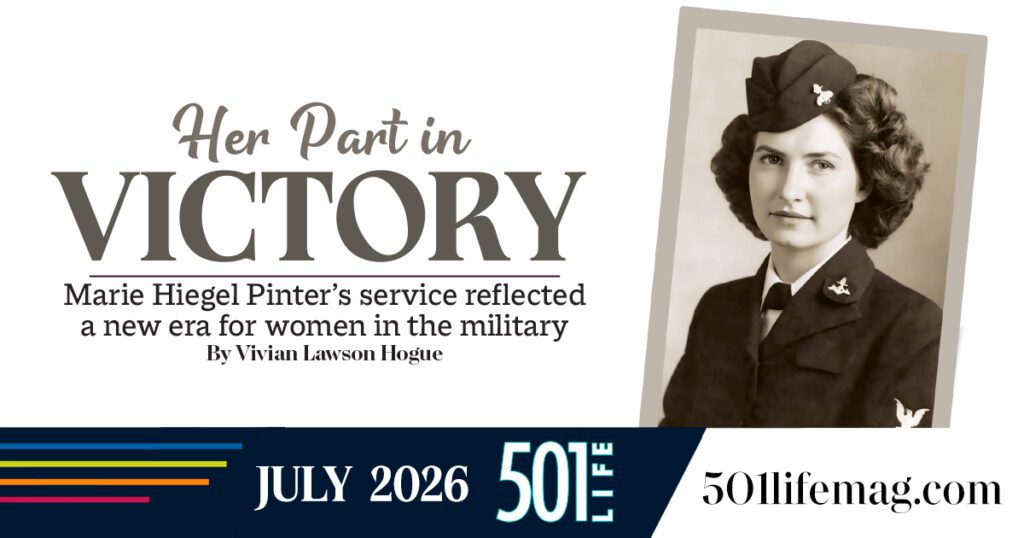
Marie Hiegel Pinter (1920-2015) of Conway would become an enlistee for the WAVES in 1944. Marie was born to “Jake” and Catherine (Moix) Hiegel in 1920, making them the parents of six children, five boys and one girl. Jake was the owner of Hiegel Lumber Co., once located on Oak Street. Marie was a graduate of Conway’s St. Joseph High School and Mount Mary College in Madison, Wisconsin, where she earned a Bachelor of Science in mathematics. She became a bookkeeper and would later serve as an observer for the U.S. Weather Bureau in Dayton, Ohio.
In an interview with Nancy Mitchell for our Faulkner County Historical Society journal in 1992, Marie recalled hearing of the bombing of Pearl Harbor in 1941: “I was at home listening to the news. I was shocked.” She added that everyone did with less to help with the war cause. Consumers would eventually be issued rationing books limiting the purchases of many everyday items. Her family had to use their car less to conserve gasoline, and everyone was limited to two pairs of shoes per year. Tires couldn’t be purchased, and drives were held to collect scrap metal for war equipment and cooking grease for chemical processes.
“After arriving back in Little Rock in 1944, I passed a Navy Recruiting Office and on impulse went in to ‘inquire,’” Marie said. “I was immediately swept into a whirlwind of interviews with papers signed and processed. The next morning, I returned to be sworn in! I wanted to help the war effort and had a sincere desire to do something to fight the evil forces of Hitler, Mussolini and Hirohito.”
From that point, she and other new enlistees would take a train to New York for naval training. After boot camp, she was sent to Aerographers School Training in New Jersey, where she studied meteorology. And picture this, if you will: There were 15 female WAVES, 30 male Marines and 300 male sailors. “We had nice officers and we all got along,” she said. “Some of the older officers had trouble accepting women in the service, and one of the officers would say, in jest, ‘Hiegel, you’re a good man.’
“After graduation, our unit, with a few exceptions, was assigned to naval communications (intelligence) Sec. GYP-7 (TOP SECRET) in Washington, D.C.,” Marie said. “We were attached to a unit attempting to break Japanese code on weather information. Data was sent in a series of five- or six-digit numbers, with each number carrying a definite meaning. The thinking was that aerographers would recognize the pattern of numbers containing pertinent weather information.”
The Japanese had stationed lone weather observers on many small islands dotting the Pacific. They were given a bag of rice, a radio and a code book. According to a pre-arranged schedule, the numbers in their clear message were added to or subtracted from the numbers of a certain line on a certain page of a code book and the resulting numbers were radioed back to Japan. Our radio operators could intercept these radio messages, which had to be decoded.
The only codes the Japanese were unable to break were messages sent by some of Navajo Code Talkers serving with the Marines! At the Battle of Iwo Jima, Major Howard Connor of the 5th Marine Division had six Navajo code talkers who sent messages in their native language. “Were it not for the Navajos, the Marines would never have taken Iwo Jima,” he said.
Marie kept many memories of her career in Washington. “I was in Washington when President Roosevelt died, and I caught a glimpse of the caisson followed by the riderless horse going down Pennsylvania Avenue,” she said. “I was also there when President Truman announced the Japanese surrender. Another memory was seeing Gen. Eisenhower’s parade when he returned from the war.”
Marie was to hold varied memories and experiences that most American women did not have then, including the joyous, hysterical mobs celebrating on Washington’s Pennsylvania Avenue. The families who had lost one or more members had both pride and unfathomable grief, but held gratitude for the time to heal. The wounded in mind, body and spirit felt the same.
There have been wars since time began, and the scriptures say they will continue. For many countries, it is over one person or entity wanting personal power. For America, it is to keep our freedoms and safety as declared in our Declaration of Independence and assured in the United States Constitution. Let it be known that ours is “the land of the FREE and the home of the BRAVE” and is worth any effort to defend it for all.

- Her part in victory - July 18, 2026
- Moments that made men - June 14, 2026
- The smile at the front door - May 10, 2026