
15 Feb 2026 Making the most of our time
By Vivian Lawson Hogue
Words move around a lot. You’d be surprised to know how old the Latin word “senior” is and how many changes it has undergone. In the 1200s, it was mainly to differentiate between sons and fathers with the same name. That has not changed. In the 1500s, it acquired the meanings of “higher in rank, longer in service” and indicated wisdom and authority.
By the 1900s, it was further changed to mean “elderly” as a path to removing the hint of “old-ness.” Today, it means you can be a senior citizen, which the government considers us to be once we reach age 65. What happened to wisdom and authority? My dad, who was actually born in 1900, insisted that we address anyone as “sir” or “ma’am” if they were above 30, or in a higher position.
Things can be seniors, too! I have my Aunt Ina’s “senior” iron skillet. No one in the old days ever gave or threw away an iron skillet. Aunt Ina was 95 when she died, so my skillet could have been handed down for more than 200 years. No brand name is on the bottom, and the bottom was apparently once cracked and repaired. All I know is that she baked “pinched biscuits” in it and I bake cornbread. Well-seasoned by now, it’s as slick as a ceramic skillet and never sticks.
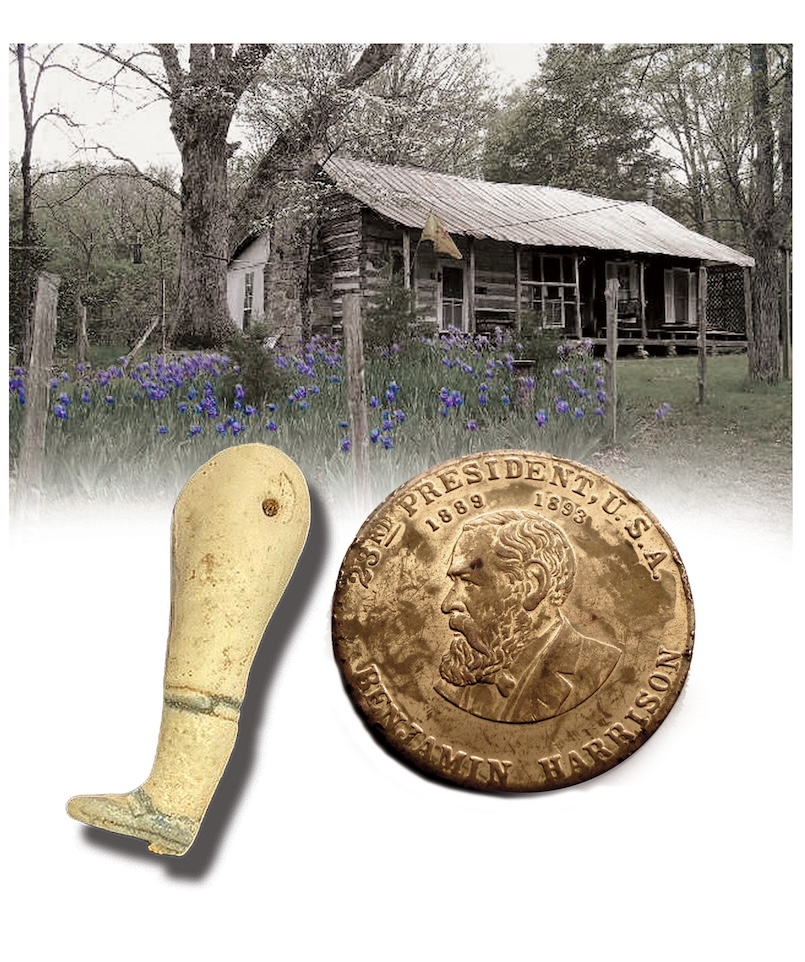
Other “seniors” in my possession are my grandmother’s purple irises that are also likely more than 100 years old. In the last three years, we have sadly lost two giant oak trees pushing 350-plus years old. I have one fig bush I call the “Centenarian” as it is about 110 years old. One treasure found while gardening was a time-encrusted metal commemorative token. I could see the profile of a man, and after scrubbing I saw the inscription, “23rd President, U.S.A., 1889-1893, Benjamin Harrison.”
I have discovered plenty of “vintage trash,” including broken colored glass, some appearing to be hand-blown pharmaceutical or spice bottles. A more recent dig produced a porcelain leg from a small china doll. I assume it belonged to a daughter of Col. George Bruce, or his granddaughter who lived in our house, but who died in 1930 at the age of 8.
My husband grew up in Mount Vernon. No, not Thomas Jefferson’s Mount Vernon, but the one just up the road from Conway. The elderly four-room home of his youth lacked the comforts of running water or an indoor toilet, and their dogs slept under the house’s open foundation. There was no heat except in the kitchen and living room. For the latter, his dad would go to Massey Hardware every year and buy a new tin wood-burning heating stove. The house still stands and is occupied.
My 115-year-old house in which I grew up knows me as well as I know it. Regardless of its age, we are only the fourth owner, with my parents being the third. The first was attorney Roy George Bruce, son of Col. Bruce. We sometimes speak with humor of the ghost of Col. Bruce. In fact, other owners of old homes have told me of their own friendly ghosts.
This began one night in 1962 when my mother and I heard footsteps in our 30-foot hall — at midnight, of course. We assumed it was my brother, a student at Hendrix College, and ignored them. Imagine our wonderment when he actually came home at 1 a.m. Even now, when we can’t find something, we grin and say the colonel must have taken it.
Several who lived a measure of their lives in our home left a part of their own histories. I have always heard and noticed that when a house is left empty long-term, it is almost as if its own life withers away. It begins to disintegrate. Nails loosen and the inside develops a distinctly different smell. The lawn grows into tall weeds. Science explains that a house actually thrives and maintains “flexible joints” when there is interior humidity and even minimal movement from a human’s day-to-day living.
At this moment, this senior house, its senior citizens and perhaps a very senior but kindly ghost, appreciate its sound structure. Like Benjamin’s presidential token, it’s a little rough around the edges but maintains its place in history.

- Moments that made men - June 14, 2026
- The smile at the front door - May 10, 2026
- Defining my best life - April 4, 2026