

14 Jun 2026 How to make the neighborhood Bermuda green with envy
By Brett Battle
The South is known for green lawns spreading from one yard to the next, colorful flowers that enhance a home’s curb appeal and front porches made for enjoying the view. But how do you achieve the lush, manicured look of a golf course at home?
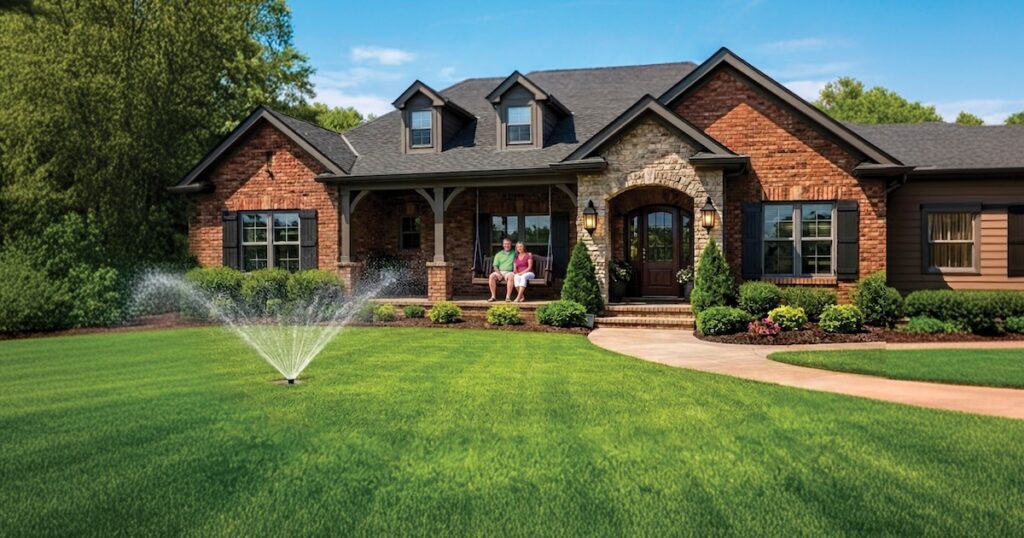
The typical Southern lawn is Bermuda (hot sunny grass), zoysia (more shade-tolerant) and, on occasion, St. Augustine and centipede. Choosing the right grass is imperative, and there are five key techniques to ensure success.
In our area of Arkansas, we are about 75% Bermuda grass, 20% zoysia grass, and 5% each of St. Augustine and centipede. Choosing the right grass depends a lot on how much sun or shade you have, as well as your ability to care for it. Further, cost is a factor, as zoysia is about twice that of Bermuda. Why the cost factor? Because Bermuda fields can be cut every six months, while zoysia can only be cut every 18 months.
Bermuda is a low-maintenance grass that thrives in full sun and requires minimal water. Zoysia is a much better choice for shade, even though it will grow well in the sun. But keep in mind that when choosing zoysia, it is a slower grower with a much higher need for water.
The techniques for success boil down to these five areas: irrigation, fertilization, weed prevention, lawn maintenance and pest awareness.
Irrigation: In the case of both types of grass, it is better to water once or twice a week, depending on the season, and water longer and deeper. This is far better than watering more often and shallower. When the season gets very hot, Bermuda will survive much better in drought conditions than zoysia, which requires more water to thrive.
Fertilization: This can be treated the same for both types of grass. The first step every year would be a soil sample to determine the soil and grass needs. Here in Arkansas, we are very lime-deficient in our soil. However, before adding any fertilizer you should do a soil test. You can take a small amount of soil from two or three different locations, put it in a Ziploc bag and take it to the Faulkner County Extension Office, and they will do a soil test for you. It is not uncommon for average lawns to need 15 to 20 pounds of pelletized lime per 100 square feet. That can be as much as 300 to 500 pounds per front and back lawn. Once you have the test done and the lime added, you then add the fertilizer the test tells you is needed.
Most people just want to add bags of 13-13-13 because that is what their fathers always did. However, that may not be what your lawn needs. Triple 13 is also an instant all-in-one fertilizer, whereas you are better off with a coated time-release. It is best to fertilize in May, July and September.
Weed Prevention: Prevention is the key factor here. Weeds are treated either pre-emergent or post-emergent. Pre-emergent you put out in spring for summer weeds and fall for winter weeds. Then, in late winter for spring weeds. If the weeds are already up and present, you will need to spray with a post-emergent liquid spray.
Lawn Maintenance: Before the grass has turned green in the spring, it is a good time to cut it short and low. You can then take a stiff lawn rake and rake all the thatch and undergrowth out of it. Then, as the season goes along, you need to ever so slowly raise the deck on your mower height. You do not want to be cutting low and scalping the lawn in the heat of summer.
Pest Awareness: We can have a number of pests and fungal issues in southern lawns. Too many to touch on here. But a common pest in the middle of summer is the armyworm. When you see them in your neighbor’s yard or yours, spray them with insecticide. They are easy to kill. Also, if you are too late and they have already scalped your lawn, don’t worry too much, as they eat the tops off and keep moving. They do not usually damage the roots. They are nature’s lawnmower.
If you follow these tips, your lawn will be the envy of the neighborhood and the perfect place for front-porch swinging with a view.