
04 May 2026 Harding University partners with first responders during annual disaster drill
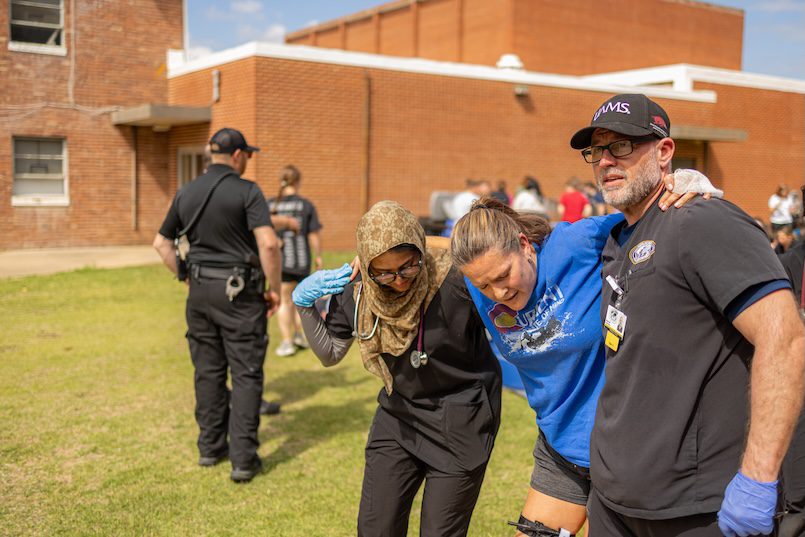
SEARCY — Harding University conducted its annual community-wide disaster drill on April 22, in the Rhodes-Reaves Field House, located at 204 S. Blakeney Street. This year’s exercise simulated an explosion and fire.
“One of the greatest strengths of living and working in this community is the close partnership between the City of Searcy and the University,” said Craig Russell, director of public safety. “From supporting one another in critical moments to training together for complex, real-world emergencies, we’ve built a strong, ongoing commitment to collaboration. That shared effort continues to make both our campus and community safer, more resilient and better prepared for whatever lies ahead.”
Since 2002, the University has coordinated disaster drills to facilitate a test of its emergency notification system and processes, allow practice for emergency communications protocol for administrators and measure the timeliness of community first responders. The University cooperates with area emergency personnel, including Searcy Fire Department, Northstar EMS ambulance service, Searcy Police Department, Unity Health and White County Office of Emergency Management. Previously staged events include simulations of an earthquake, hazardous waste, explosion, tornado and active shooter.
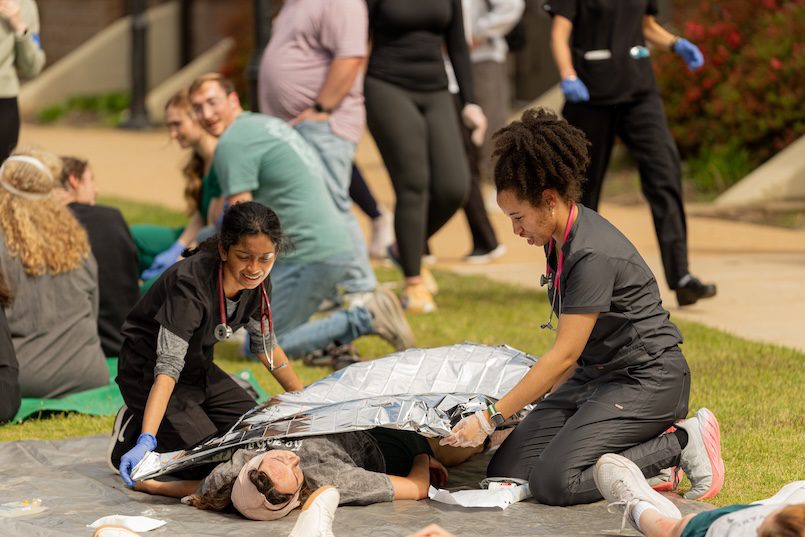
Faculty from Carr College of Nursing and College of Pharmacy, as well as the department of mental health and wellness and the physician assistant program, coordinated student participation in the event. Health sciences students acted as medical staff on the scene to triage students acting as victims and utilized specific injury scenarios.
“The disaster simulation has become a cornerstone of interdisciplinary training for our students in nursing, physician assistant, pharmacy and counseling programs,” said Dr. Karen Kelley, associate professor of nursing. “Immersing students in a crisis scenario allows them to engage with the complexity and urgency of real-world disaster response. They make rapid decisions, manage scarce resources and address both physical and psychological needs. This experience strengthens essential competencies such as triage, emergency care and collaborative response, equipping them to lead with confidence in the evolving health care landscape.”
The University had more than 100 participants involved in the drill.