
07 Sep 2025 Protecting our seniors
By Campbell McLaurin, Deputy Commissioner, ASD
To further its ongoing investor education mission, the Arkansas Securities Department (ASD) is sounding the alarm to elderly Arkansans and their loved ones about the proliferation of elder financial abuse. The ASD is the state regulator of the securities, nondepository mortgage and money services industries in Arkansas. Part of the ASD’s regulatory responsibilities is to enforce consumer protection laws against unlicensed bad actors who commit fraud in the state. The ASD also has an Investor Education Program designed to improve financial literacy across Arkansas and to teach fraud prevention to the public.

In recent years, the ASD’s enforcement staff has witnessed a substantial uptick in scams targeting the state’s elderly population. There are numerous reasons for this upsurge, but one primary contributor is that most older people belong to at least one social media platform. While there are many positive benefits of social media, inventive scammers can easily curate fake profiles and commit fraud from anywhere in the world.
Popular online frauds include social media scams, romance scams and so-called pig butchering scams. A romance scam is a type of fraud where the bad actor creates a fake online identity to gain a victim’s affection and to defraud them out of money. A pig butchering scam is a type of fraud where the scammer builds a relationship of trust with the victim to steal money from them over a long period of time. After a relationship of trust is built, the scammer may introduce a lucrative investment opportunity to the victim and encourage numerous investments over time.
The name “pig butchering” is derived from the Chinese phrase “sha zhu pan,” meaning “fattening the pig before slaughter.” All these popular scams include building an element of trust with the victim and often encourage the use of cryptocurrency, which is difficult for regulators and law enforcement to trace.
There are many reasons why fraudsters target the elderly at higher rates than younger populations. Older adults are more likely to possess significant savings accumulated over a lifetime. The elderly are generally more trusting and less likely to report fraud to authorities. Also, age-related cognitive impairments and social isolation can increase a senior’s susceptibility to a scam.
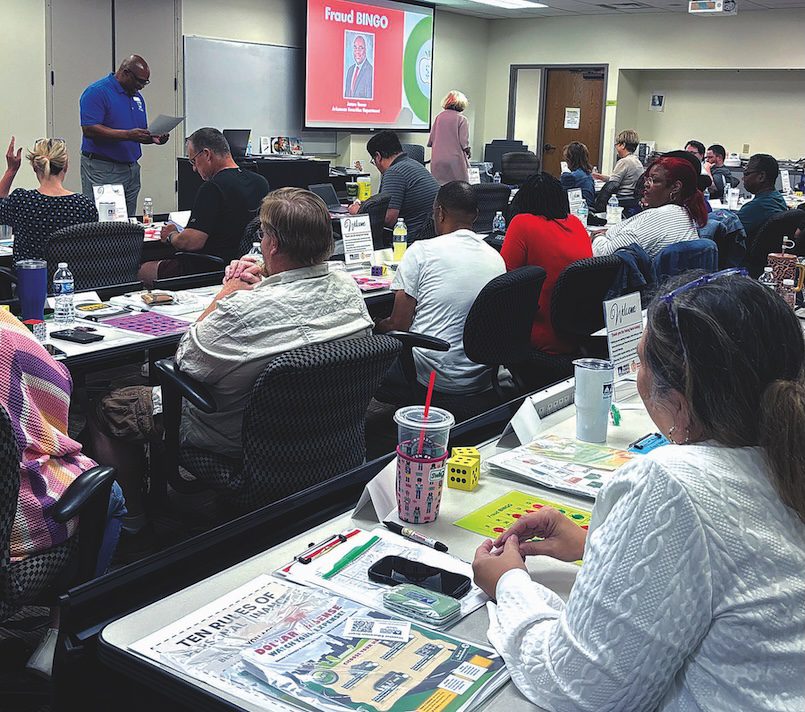
The increase in frauds against the elderly is not limited to Arkansas but is a trend occurring nationwide. The trend is so alarming that many financial experts are referring to elder financial abuse as “the invisible crime of the 21st century.” According to the FBI’s Internet Crime Complaint Center, older Americans reported a total of $4.885 billion in fraud losses from 147,127 complaints nationwide in 2024. This includes a reported 1,063 victims in Arkansas who suffered a total of $27,253,501 in losses. While these figures are shocking, the actual numbers are substantially higher because older adults are less likely to report fraud due to a lack of know-how, psychological traumas or embarrassment.
The consequences of elder financial abuse are devastating. If older victims lose all or part of their life savings, they have less time and means to recover financial stability. Also, the costs of financial abuse extend well beyond monetary injuries and can lead to depression, anxiety and other psychological traumas. To prevent becoming a victim of fraud, the ASD encourages older investors to beware of the “red flags” of investment frauds. Unsolicited investments that are “guaranteed,” “secret,” or “low risk with high returns” should be avoided.
The ASD will continue to educate the public, investigate complaints of fraud, and work with other government authorities to obtain justice for injured Arkansans wherever possible. The staff of the ASD asks anyone with suspicions of possible elder financial exploitation to contact the agency at 800.981.4429 or email [email protected]. The ASD’s Investor Education Program provides financial presentations to schools, civic groups and other organizations throughout the state. A speaker request form and additional resources on investing and fraud prevention are available at securities.arkansas.gov.