
07 Sep 2025 First orders of business
By Vivian Lawson Hogue
There was something comforting about the repetitious sound made by the old generator at Conway Corporation. It hummed my 3-year-old self to sleep, and mattered not to me that it was providing electricity for our small population of 5,700. Through our open windows at night, its rhythm was heard very clearly, serving as the percussion section in an ensemble that included the soft clapping of leaves of a large sycamore tree. A bullfrog sang bass while its raspy tree-frog cousins trilled soprano parts. A katydid was self-encouraged to take a solo, and, well … katydid. If rain fell and thunder held the cymbals, it was magical.
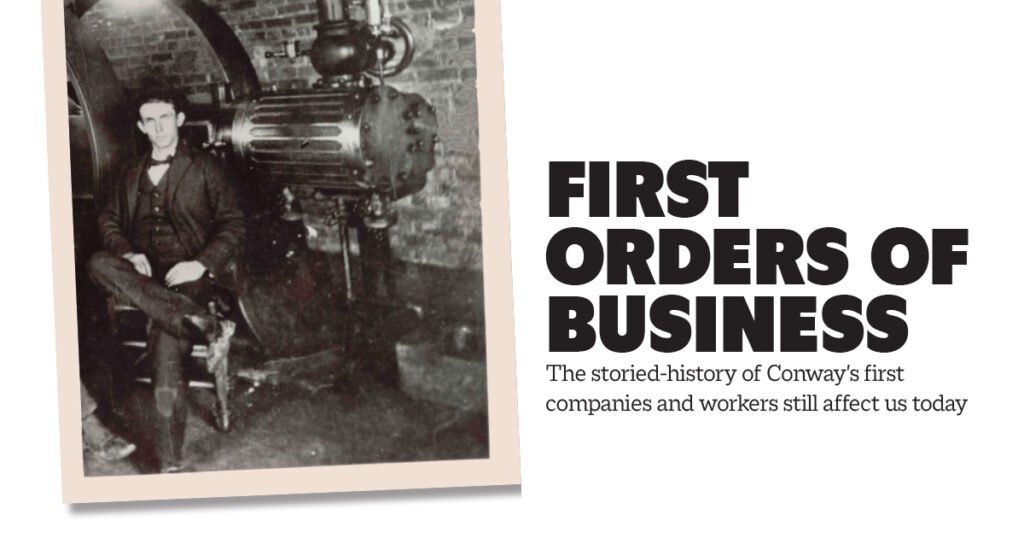
Before 1895, the Conway Electric and Manufacturing Co. struggled with equipment, logistics and ideas. In that year, however, the right people put ideas and people together. Professor George Burr, a natural and physical science instructor at Hendrix College, designed the plant and its systems. A year later, the plant was built followed by the installation of a small number of power lines on cypress poles. The company received its current name in 1929.
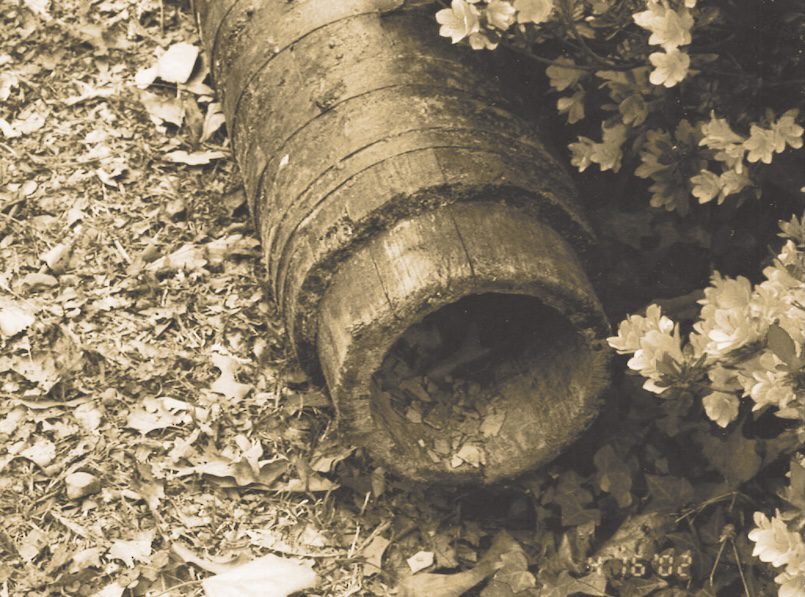
Progress with its water system was slower for various reasons. By 1912, wooden water mains were failing and were replaced with cast iron pipe. In about 2009, the concrete street in front of my antique home was broken up to install new water mains, and although the wooden mains were not in use, some still remained underground. Workers asked if I would like one and I did. It was constructed with slightly curved wooden slats coated with tar and held together with metal bands.
Conway Corp was the first corporate business in town, but there were already other businesses of importance. Cotton was the primary industry for Faulkner County. All of the steps to get it to the baling incurred costs, but also made “good money.” These steps included the costs of equipment and supplies, planting the seeds, paying pickers of all ages and both races, hauling loads to one of 22 county gins, and paying the ginner.

My husband, Gerald, grew up in Naylor, where he, his mother and sister picked cotton. His father was employed at Dean Milk Co. in Conway. School was dismissed in May and resumed after July 4. Classes continued until around Sept. 1 or until farmers said the cotton was ready to pick. School resumed in October when harvesting ended.
While harvesting, the pickers dropped cotton into bags with tar-coated bottoms, which prevented wear as they were pulled along on the ground. When bags reached the 20- to 35-pound limit, they were emptied into a wagon and picking began again. Had there been drought conditions, gloves were worn to pick the cotton, including the sharp, pointed boll tips. If not, the cotton was pulled from the bolls. Lunches were generally Vienna sausages, pork and beans and crackers or a fried bologna sandwich.
Between the ages of 7 and 15, Gerald spent a month in the fields from 7 a.m. until 5 p.m. Workers earned $3 per 100 pounds, and his earnings paid for school clothes. Tuf-Nut jeans cost $2.50, but Converse All-Star basketball shoes likely cost twice as much. All were purchased in Conway when Mr. Keathley’s “show bus” ran from Mount Vernon to Conway on Saturdays for residents’ shopping or movie attendance.
The hurried lives of today’s residents bring complaints of slow and long trains. However, were it not for the railroad, we would not be what we are now, but possibly just another “wide spot in the road.” Its completion was our good fortune.
In 1964, Robert Gatewood published a book entitled “Faulkner County, Arkansas. 1778 – 1964.” His research and interviews provided authenticity that all accurate histories require. His coverage of Conway showed early businesses developing according to what was needed by Conway and the county. By 1880, seven years after Conway was declared a county, there were physicians, druggists, attorneys, saloons, hotels, wagon yards, blacksmiths, coopers (barrel-makers), broom makers, saddlers and brick makers. Food came from backyard gardens and farm animals. It was “every man for himself,” and with success.
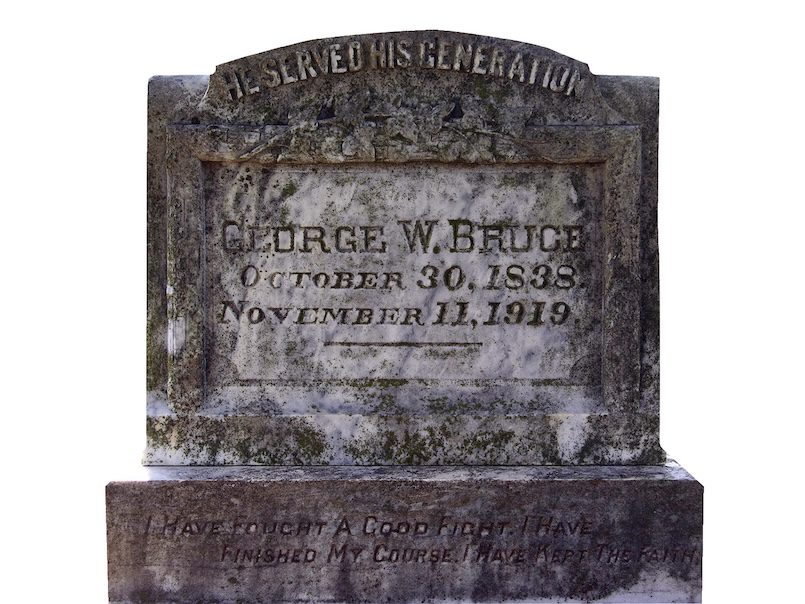
When we moved into our 1910 home in 1946, it still had darkly varnished woodwork, single light bulbs hanging from the ceiling by cords, a large butler’s pantry with shelves for canned vegetables and meats, and a pass-through for a maid to enter the dining room. A screened back porch held a floor access to the well underneath. The wood lattice and scent-heavy honeysuckle provided shade. I still live inside this part of history built by Col. G.W. Bruce, one of the earliest businessmen in Conway’s history.
Bruce’s tombstone states at the top, “He Served His Generation.” The same could be said of his colleagues. Attributed to him at the bottom is, “I have fought a good fight, I have finished my course. I have kept the faith.” (This is a quote from II Timothy 4:7.) Oh, that we could all say the same!

- They found their ‘true grit’ - January 5, 2026
- And that’s what Christmas is really all about - December 2, 2025
- Giving thanks - November 4, 2025