

03 Aug 2025 All eyes on reading
By Mark Oliver
Imagine being back in preschool, where your days are filled with toys, snacks, naps and arts and crafts. Suddenly, the door opens and two large, green amphibians appear. It’s Croaker and Dazey, the Toad Suck Daze mascots, with arms full of storybooks, musical instruments and enough excitement to light up the whole classroom. Your eyes light up, not just for the mascots, but for the worlds waiting to be explored behind each page.
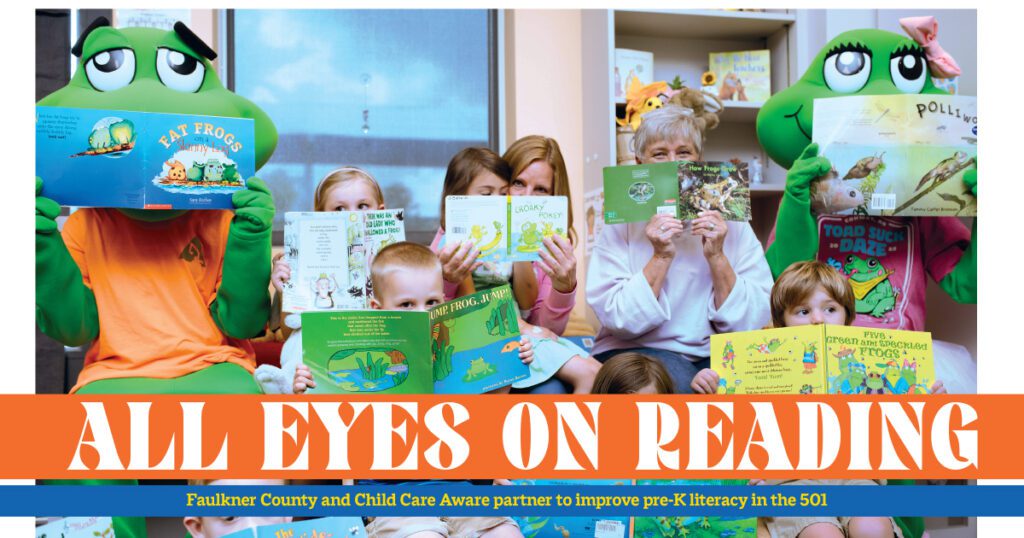
That’s the power of reading.
What might seem like a silly moment is actually part of a powerful movement: improving pre-K literacy in the 501. By age 5, a child’s brain is 90% developed. Yet many families miss out on one of the simplest, most powerful tools to boost their future: books.
“Reading together is one of the most quality times you can have as a family,” Child Care Aware Infant Toddler Specialist Carol Crockett said. “From choosing books with simple text and bright colors to using expressive voices and gestures, it is both easy and fun to bring any story to life.”
Her team at Child Care Aware of Northcentral Arkansas recently collaborated with the Conway Area Chamber of Commerce to deliver the premier reading event of the summer: the Toad Suck Daze Family Reading Challenge.
“Because reading at a young age is so important, I loved the thought of doing a reading challenge for our preschoolers,” Crockett said. “Not only did it encourage reading, but it engaged families, too. I asked the Conway Area Chamber of Commerce for their help in creating a program, and they couldn’t wait to jump in and spread the word.”
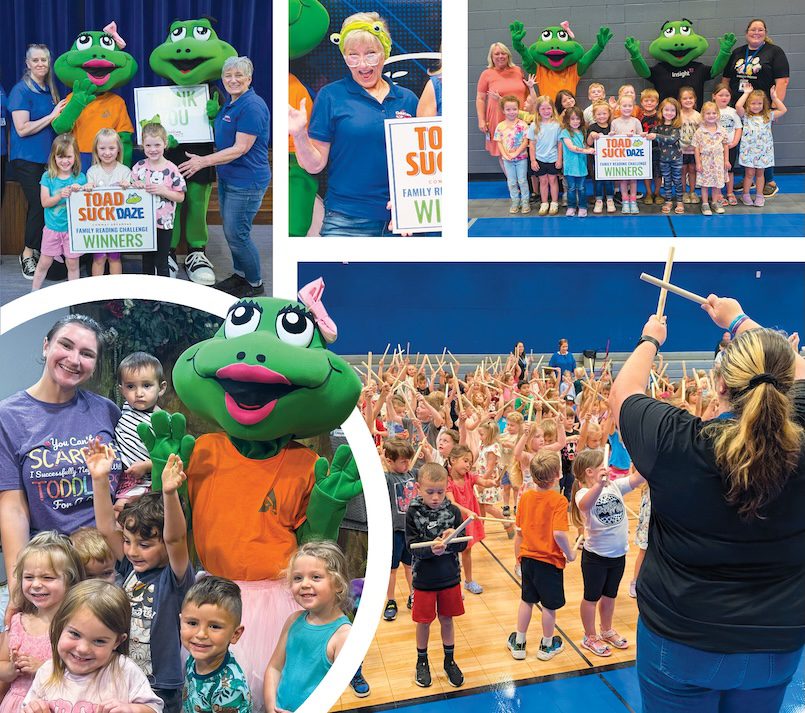
Open to preschoolers and their families across Faulkner County, the Toad Suck Daze Family Reading Challenge inspired parents and grandparents to pick up books together with their children, focusing on participation, not quantity. Joined by Croaker and Dazey, Crockett and her team visited five randomly selected participating schools with storybooks, musical instruments and a single mission: to show how fun reading can be.

“Croaker and Dazey brought excitement and energy to every classroom we visited,” Crockett said. “They participated in music time by singing, dancing, playing musical instruments, giving high fives, hugs and pictures with the kids. The facilities that participated loved it and the kids in every school we went to were giddy with smiles and enthusiasm.”
In a blend of literacy, local flair and amphibian-themed fun, the challenge adds a huge splash to Toad Suck Daze’s broader mission of supporting early childhood education while supporting Child Care Aware’s mission for community and family engagement.
Following an impactful first challenge, Crockett and her staff are already hard at work planning for its return next April. “The Conway Area Chamber of Commerce was amazing in making this dream a reality,” she said. “Our goal was to get families involved and connected with their school and home and it was a resounding success. Despite having a little more than two weeks to plan everything out, we still had 540 families participate and read nearly 5,000 books. We feel confident that it will grow even more next year.”
Research shows that skipping out on reading with young children, even newborns, can lead to struggles that could carry into adulthood such as limited vocabulary, learning setbacks and difficulties adjusting to the workforce. Even just 10 minutes of reading a day can make a huge difference, building bonds, boosting confidence and nurturing curiosity.
“Children remember laughter, hugs and the time you take to read to them,” Crockett said. “The more strong, positive interactions a child has with a caring adult, the stronger their neurons grow and the healthier their brain development becomes. Building a positive association with reading can lead to a lifelong love of learning.”
Reading should feel like an enjoyable experience, not a chore. For parents and grandparents looking to take the leap with their child, don’t forget to have fun. “Use different voices for each character in the story,” Crockett said. “Tell the story with excitement, joy and amazement. At the end, go back and ask questions like ‘Why do you think they felt that way?’ and ‘What would you have done?’ Children desire that one-on-one time with you.”
Child Care Aware of Northcentral Arkansas supports early childhood education across 14 counties by offering professional development, coaching, technical assistance and business guidance to childcare providers. Through strong community partnerships, it tailors its outreach to meet the unique needs of each county while fostering deeper connections with families.
So, the next time your child reaches for a book, lean in and join the adventure with them. The pages aren’t just stories, they’re stepping stones to a bright future.

Effective strategies to teach infants and toddlers to read
To help infants and toddlers develop language and literacy skills, focus on creating a positive and interactive environment centered around books and language, rather than attempting to teach them to read in a formal way.
1. Talk and interact with your child often:
• Narrate your daily activities.
• Respond enthusiastically to their attempts to communicate.
• Engage in back-and-forth “conversations” by imitating their sounds.
• Introduce new words and explain their meanings in context.
2. Make reading aloud a daily habit:
• Start early, even with newborns.
• Choose books with bright colors and simple texts.
• Use expressive voices and gestures to make stories come alive.
• Point to words as you read, demonstrating the connection between spoken and written language.
• Let your child turn the pages and explore books independently.
• Don’t be afraid to reread favorite books, as repetition helps learning.
• Ask questions about the story to engage your child.
3. Provide a print-rich environment:
• Keep books accessible in different areas of your home.
• Point out letters and words in everyday settings (cereal boxes).
• Provide writing materials like crayons and paper for exploration.
4. Incorporate language and literacy into playtime:
• Sing songs and nursery rhymes to develop phonological awareness.
• Play word games focusing on sounds and rhymes.
• Use alphabet blocks or magnets to explore letters.
5. Visit the library and participate in story time:
• Introduce your child to the library’s resources and programs.
• Encourage them to choose books that interest them.

- Youth of the Month: Canaan Gilbert - December 1, 2025
- Going the Extra Myles - November 4, 2025
- Strength in service - September 30, 2025