

30 Sep 2025 501 Hometown Hall of Famers: Mickey O’Quinn
By David Grimes
Mickey O’Quinn was a great player and coach, but his biggest contribution to sports may have been his developmental and innovative work in athletic strength training.
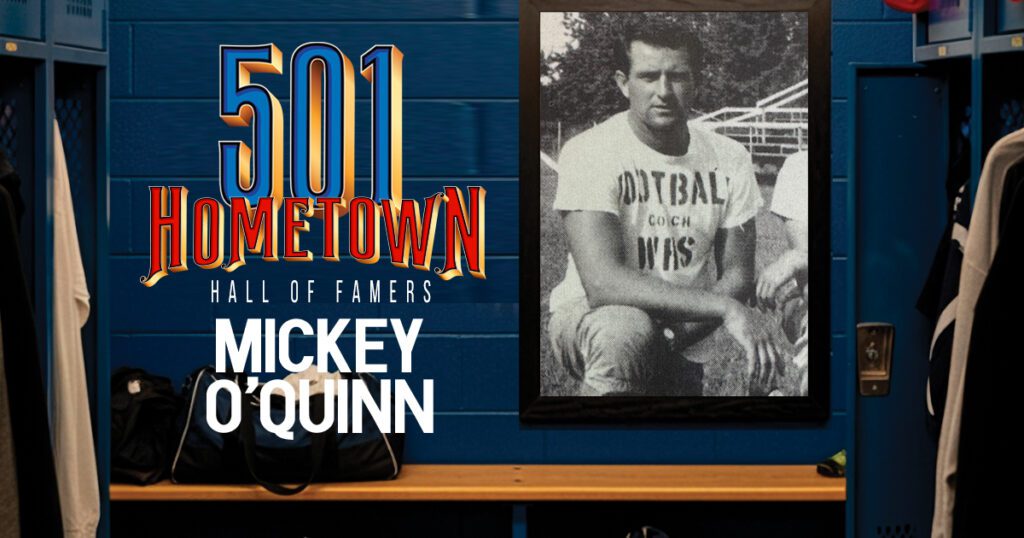
O’Quinn was inducted into the Arkansas Sports Hall of Fame (ASHOF) in 2005 as part of the 47th class, along with Bud Brooks, Maurice Carthon, Scott Hastings, Cortez Kennedy, J.P. Lovelady, Scottie Pippen, Carl Sawatski, Hal Smith, Terri Johnson, Doyne Williams and Nancy Williams. O’Quinn was born in McRae (White County) in 1929. He graduated from Malvern High School in 1948, where he played center and linebacker on the football team and was named all-state. He also played basketball for the Leopards.
He ended up at Little Rock Junior College (now the University of Arkansas at Little Rock) playing for Head Coach Jimmy Karam, who later went on to be well-known for his men’s stores in the capital city. The Trojans won the 1949 junior college national championship, going undefeated and winning the Junior Rose Bowl in Pasadena, California.
O’Quinn then attended Henderson State Teachers College, now Henderson State University, in Arkadelphia. He played football for the Reddies from 1950 to 1952. He was named All-AIC in 1951 and 1952, served as team captain in 1952, and was named Reddie Athlete of the Year in 1953.
He got into coaching at the high school level, serving as head football coach and athletic director at Parkin, Arkadelphia and Warren. His Warren football teams had a stretch where they went 54-9. He was named head coach for the East squad for the 1960 Arkansas High School All-Star football game. He also coached some basketball and track along the way, as well as coaching the Warren swimming teams to multiple state championships and setting dozens of state records.
During the late 1950s, while O’Quinn was coaching at Warren, fellow ASHOF inductee Jimmy “Red” Parker was the coach at rival Fordyce High School. Their matchups are still legendary. Years later, the Red Parker-Mickey O’Quinn Trophy was established and presented to the winner of that game each season.
A big part of O’Quinn’s success with his teams was how he trained his athletes. He was a pioneer in strength training and conditioning on the high school level, including preseason and offseason workout regimens.
Back then, many coaches thought that weight training would add bulk and pounds and make athletes slower. But O’Quinn knew that proper training techniques could not only increase strength but increase agility and speed and help lessen the chance of injury. He was also an early adopter of using film to break down games and practices.
After eight seasons at Warren, he left at the end of the 1964 school year to attend the University of Arkansas to work toward a master’s degree. In the fall of that year, he served as a graduate assistant for the Razorbacks under Coach Frank Broyles when the Hogs went 11-0 and won the 1964 national championship. While at the U of A, he earned both master’s and doctorate degrees as he continued to serve on the football staff. He brought his strength and conditioning philosophies to the Razorbacks with the same success he had on the high school level.
In 1969, Dr. O’Quinn returned to Henderson State, where he served his alma mater in many roles, including professor, associate dean, executive athletic director and chair of the Health, Physical Education and Recreation (HPER) Department. He retired in 1998.
During his tenure at Henderson, O’Quinn continued to be proactive in regard to athletic training. He helped the university acquire new and innovative weight-training equipment.
The Mickey O’Quinn Scholarship has been established at Henderson State for graduates from Warren, Malvern or Arkadelphia high schools who plan to earn degrees in teaching or coaching. O’Quinn is a member of the Warren Lumberjacks Hall of Fame and was inducted into the Henderson State University Athletic Hall of Honor in 1997 as part of its first class of honorees. He passed away in 2008 at the age of 78.